
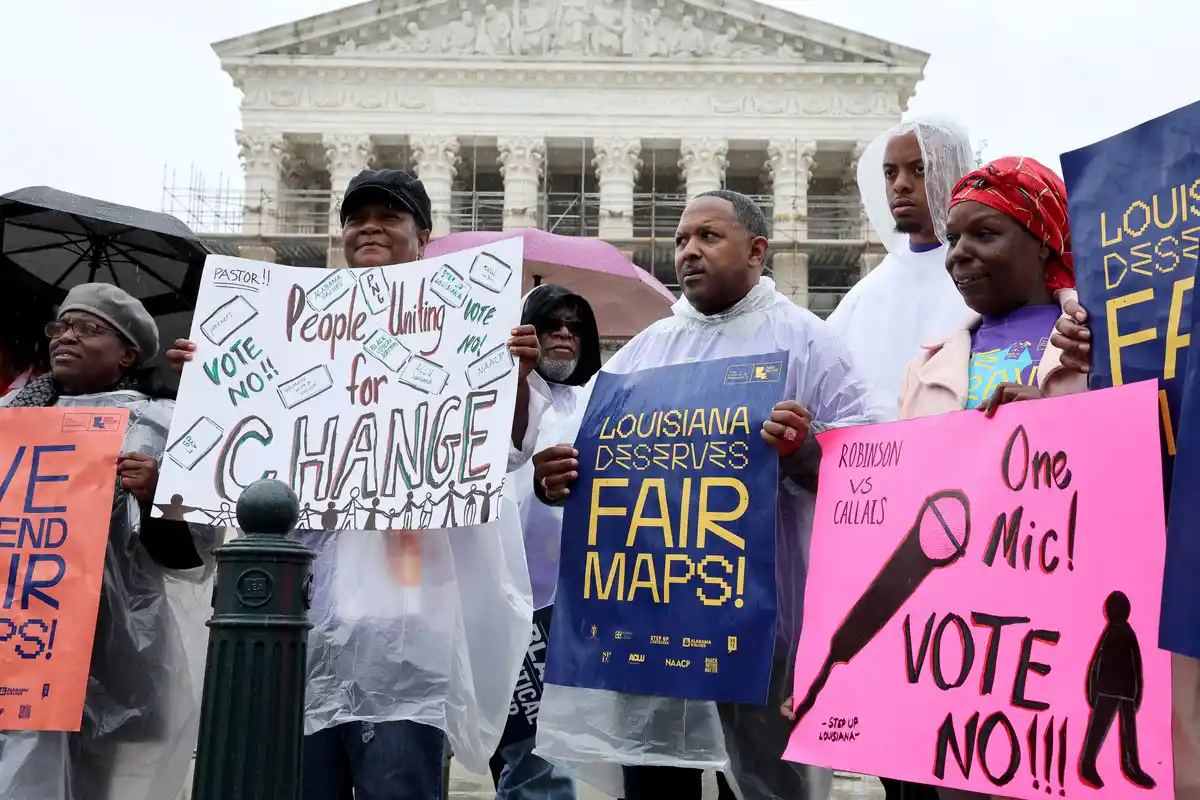
The Supreme Court’s 2026 decision in Louisiana v. Callais has emerged as one of the most consequential voting-rights rulings of the year, prompting fierce debate over how much protection remains under the Voting Rights Act of 1965. In a 6–3 decision issued on April 29, the Court rejected a Louisiana congressional map that had been created with a second majority-Black district, holding that the map constituted an unconstitutional racial gerrymander because the Voting Rights Act did not require Louisiana to create that additional district.
The immediate dispute involved congressional redistricting in Louisiana, but the implications reach far beyond one state. The ruling changed the legal framework for Section 2 of the Voting Rights Act, making it substantially more difficult for minority voters to challenge electoral maps that they argue dilute their political power. Critics have described the decision as another major blow to the landmark civil-rights statute, while the Court’s conservative majority presented its reasoning as an effort to reconcile voting-rights law with the Constitution’s restrictions on racial classifications.
For an editorial analysis of the Supreme Court’s most consequential cases, Louisiana v. Callais deserves particular attention because it illustrates a fundamental question about American democracy: How should the law protect racial minorities from voting discrimination without requiring states to make racial classifications when drawing political boundaries?
The Louisiana Redistricting Fight
The case began with Louisiana’s congressional redistricting process after the 2020 census. Louisiana initially adopted a congressional map containing only one majority-Black district, despite Black residents making up a significant portion of the state’s population. A federal court concluded that the map likely violated Section 2 of the Voting Rights Act because Black voters did not have an equal opportunity to elect representatives of their choice.
Louisiana subsequently enacted a new map containing a second majority-Black congressional district. That change triggered another legal challenge. The plaintiffs argued that the new map was an unconstitutional racial gerrymander because race had played too significant a role in drawing the district boundaries.
The Supreme Court ultimately sided with the challengers. The majority concluded that Louisiana’s second majority-Black district was not required by Section 2 under the Court’s revised interpretation of the law. Because the state had used race to create the district without a sufficiently compelling justification, the Court concluded that the map violated the Equal Protection Clause.
That reasoning placed the Voting Rights Act and the Constitution’s equal-protection principles at the center of the case.
What the Supreme Court Actually Changed
The most important part of Louisiana v. Callais was not simply what happened to Louisiana’s congressional map. It was the Court’s reinterpretation of Section 2.
Section 2 of the Voting Rights Act prohibits voting practices that result in racial discrimination and deny or abridge citizens’ opportunity to participate equally in the political process. Congress significantly strengthened the provision in 1982 after the Supreme Court had previously required proof of discriminatory intent in certain voting cases. The amended law focused on discriminatory results and whether minority voters had an equal opportunity to participate and elect candidates of their choice.
For decades, courts relied on the framework established in Thornburg v. Gingles to evaluate racial vote-dilution claims. The framework examined factors such as whether a minority population was sufficiently large and geographically compact to form a majority in a reasonably configured district, whether minority voters were politically cohesive, and whether majority voters tended to vote as a bloc against minority-preferred candidates.
The Supreme Court did not formally eliminate the Gingles framework. Instead, the majority said it was updating the framework to reflect constitutional requirements and developments in redistricting law.
But that distinction has become central to the controversy surrounding the decision.
The New Burden on Voting Rights Plaintiffs
Under the new framework announced in Callais, plaintiffs challenging a congressional map under Section 2 face substantially more demanding requirements.
Among other things, plaintiffs must present alternative districting maps that do not rely on race as a districting criterion and that satisfy the state’s legitimate districting objectives, including traditional redistricting principles and stated political goals. The Court also said plaintiffs must account for partisan affiliation when analyzing whether voting patterns are actually racially polarized.
That requirement is especially significant in modern American elections because race and political party affiliation frequently overlap.
The Court’s majority reasoned that Section 2 cannot be interpreted in a way that transforms partisan differences into racial discrimination automatically. In the majority’s view, the Fifteenth Amendment prohibits intentional racial discrimination in voting, and Congress cannot use ordinary legislation to create a broader constitutional right than the amendment itself protects.
The practical consequence is that minority voters challenging a map may have to do more than demonstrate that their voting power has been diluted. They may also need to establish a strong inference of intentional racial discrimination.
That distinction could make future Section 2 cases considerably harder to win.
Why Critics Say the Voting Rights Act Was Gutted
Justice Elena Kagan, joined by Justices Sonia Sotomayor and Ketanji Brown Jackson, offered one of the strongest criticisms of the ruling.
In dissent, Kagan argued that the majority’s supposedly technical modifications to Section 2 effectively destroyed the statute’s ability to address classic forms of minority vote dilution. She emphasized that Congress amended Section 2 specifically to move away from an intent-based standard and toward a test focused on discriminatory effects.
The dissent argued that the new standard could allow states to defend maps using race-neutral explanations such as traditional redistricting principles or partisan objectives, even when the practical effect is to weaken minority voters’ ability to elect their preferred candidates.
Kagan warned that if states can simply characterize their decisions as partisan rather than racial, Section 2 could become ineffective in many of the cases it was designed to address.
This is why voting-rights organizations and civil-rights advocates have characterized Callais as an effective gutting of Section 2. The criticism does not necessarily mean that the Court formally repealed the Voting Rights Act. It did not. Instead, critics argue that the Court changed the legal test so dramatically that one of the statute’s most important remaining protections could become extremely difficult to enforce.
From Shelby County to Callais
The Callais decision is also significant because it represents another stage in the Supreme Court’s long-running transformation of federal voting-rights protections.
In 2013, the Court’s decision in Shelby County v. Holder invalidated the coverage formula used by Section 4 of the Voting Rights Act. That effectively disabled the preclearance system of Section 5, which had required certain jurisdictions with histories of voting discrimination to obtain federal approval before changing election laws or procedures.
The result was a major shift from preventative federal oversight toward after-the-fact litigation.
Section 2 remained one of the most important nationwide mechanisms available to challenge discriminatory election practices. In 2023, the Court reaffirmed the usefulness of Section 2 in Allen v. Milligan, an Alabama redistricting case involving Black voters.
Callais now significantly narrows that earlier approach.
The Court’s majority specifically said it had not formally overruled Allen. Instead, it distinguished the earlier case because Alabama had not defended its map on the same partisan grounds presented by Louisiana.
That distinction may be legally important, but the effect of Callais could nevertheless be substantial.
The Race Versus Partisanship Problem
One of the hardest questions raised by the case is whether courts can realistically separate racial and partisan motivations when evaluating congressional maps.
American elections are highly polarized. Black voters, Latino voters and white voters frequently exhibit different voting patterns, while political parties also have increasingly distinct racial and demographic coalitions.
The Callais majority acknowledged this problem but concluded that courts must examine whether alleged racial polarization can actually be distinguished from partisan affiliation. Plaintiffs therefore face a heavier evidentiary burden when attempting to establish that racial discrimination, rather than ordinary partisan politics, caused the alleged dilution.
Supporters of the ruling argue that this requirement is necessary to prevent courts from turning ordinary political disputes into racial-gerrymandering cases.
Critics see the issue differently.
They argue that requiring minority voters to separate race from party affiliation ignores the realities of American elections. If racial identity and partisan preference overlap significantly, proving that a district was drawn specifically because of race may be extremely difficult even when the resulting map substantially weakens minority political representation.
That disagreement goes to the heart of the editorial debate surrounding the case.
What the Decision Could Mean for Minority Representation
The consequences of Callais could extend beyond Louisiana as states redraw congressional and legislative districts.
If state lawmakers know that partisan justifications can make Section 2 challenges more difficult, voting-rights plaintiffs could face greater obstacles when attempting to challenge maps that reduce the electoral influence of racial minorities.
The ruling does not give states unlimited authority to discriminate. Intentional racial discrimination remains constitutionally prohibited. The Supreme Court also did not declare Section 2 unconstitutional. Instead, it narrowed the circumstances in which a racial vote-dilution claim can succeed.
That distinction matters.
Nevertheless, the practical concern raised by critics is that discriminatory intent can be extremely difficult to prove. Legislative redistricting involves thousands of lines, demographic data, political considerations, geographic boundaries and competing interests. Evidence of explicit racial motivation may rarely appear in a clear or easily identifiable form.
As a result, the new legal framework could shift the balance of power toward states defending challenged maps.
The Broader Debate Over the Voting Rights Act
The larger question is whether the Voting Rights Act should primarily protect voters against intentional racial discrimination or whether it should also provide a remedy when electoral structures produce significant racial inequalities.
The Court’s conservative majority has emphasized constitutional limits on the government’s use of race. From that perspective, requiring states to draw districts based on racial demographics can itself raise constitutional concerns.
The dissent, however, sees the issue through the history of voting discrimination. Congress created and repeatedly renewed the Voting Rights Act because racial discrimination often operates through systems that do not openly announce discriminatory intentions. A law focused only on explicit racial motive, the dissent argues, risks leaving many forms of discrimination beyond the reach of federal courts.
That disagreement is not merely technical. It represents two competing visions of racial equality.
One emphasizes colorblind government decision-making and limits on racial classifications. The other emphasizes substantive electoral equality and the reality that historical discrimination can shape political institutions even when modern lawmakers do not openly express racist intentions.
Why This Is One of the Court’s Defining 2026 Cases
For a Supreme Court editorial ranking of the year’s most consequential decisions, Louisiana v. Callais belongs near the top because its effects could reach far beyond the Louisiana map.
The decision changes how courts will approach Section 2 challenges to redistricting. It raises the evidentiary burden for minority voters. It gives states greater room to rely on partisan and traditional redistricting considerations. And it forces future courts to confront the difficult question of how to distinguish racial discrimination from partisan politics in an increasingly polarized electorate.
Most importantly, the ruling illustrates how a constitutional protection can be weakened without being formally repealed.
The Voting Rights Act remains federal law. Section 2 remains on the books. But the meaning and enforceability of that protection have changed.
That is why critics describe Callais as another step in the dismantling of the Voting Rights Act, while supporters characterize it as a necessary correction that prevents the government from using race too aggressively in political redistricting.
Editorial Verdict: A Turning Point for Voting Rights
The Supreme Court’s Louisiana v. Callais decision should be understood as more than a dispute over one congressional district. It represents a major shift in the legal architecture surrounding minority voting rights.
The majority insists that the Constitution does not permit states to discriminate based on race and that Section 2 must be interpreted consistently with that principle. But the dissent warns that the new framework could make it nearly impossible for minority voters to challenge maps that diminish their electoral influence when lawmakers can point to partisan or race-neutral explanations.
That tension will likely define voting-rights litigation for years.
Whether one views the decision as a restoration of constitutional colorblindness or as a serious retreat from the protections Congress created in 1965, its importance is difficult to overstate. Callais has changed the rules for one of the country’s most important civil-rights laws, placing a new burden on voters who believe their political power has been diluted because of race.
The lasting question is therefore not simply whether the Voting Rights Act still exists.
It does.
The more consequential question is how much of its original power remains.


Leave a Reply