
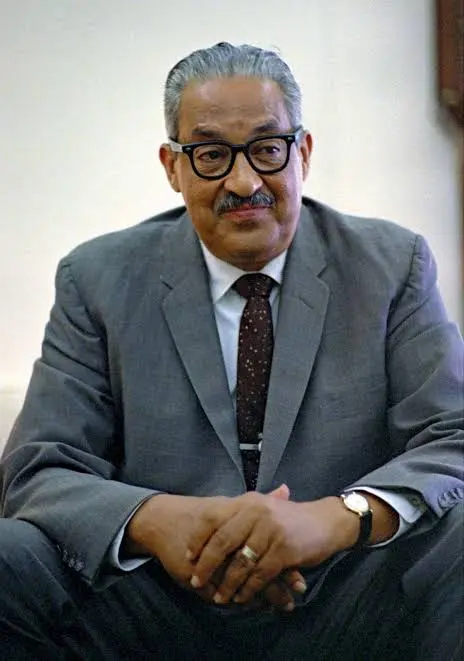
Among Thurgood Marshall’s greatest legal victories, Brown v. Board of Education stands as the defining achievement of his career. Decided on May 17, 1954, the case challenged racial segregation in public schools and fundamentally changed the interpretation of equal protection under the Fourteenth Amendment.
At the time, many American states maintained racially segregated public schools under the doctrine of “separate but equal,” established by the Supreme Court in Plessy v. Ferguson in 1896. In practice, Black students frequently received inferior educational facilities, resources, and opportunities. Even when officials claimed that separate schools were equal, segregation itself imposed significant disadvantages on Black children and their communities.
Marshall led the legal team representing the plaintiffs in Brown and four related school segregation cases. The families involved challenged policies that prevented their children from attending public schools based on race. Marshall argued that separating children into different schools solely because of their race violated the Constitution’s guarantee of equal protection.
The Supreme Court unanimously agreed. Chief Justice Earl Warren delivered the Court’s opinion, declaring that racial segregation in public education was unconstitutional because separate educational facilities were inherently unequal. The ruling rejected the legal foundation for state-sponsored segregation in public schools and overturned the separate-but-equal principle in that context.
Brown v. Board of Education became a turning point in American civil rights history. It strengthened the legal movement against segregation and provided a constitutional foundation for further challenges to discriminatory practices. However, the decision did not immediately integrate every school. Resistance from some state and local authorities delayed implementation, demonstrating that landmark legal victories often require sustained enforcement and public commitment.
Marshall’s contribution to Brown illustrates why he is remembered as one of America’s most important civil rights lawyers. His work helped transform the principle of equal protection from a constitutional promise into a powerful instrument for challenging racial discrimination.
Sweatt v. Painter: Challenging Inequality in Higher Education
Before Brown, Marshall had already helped secure important victories against discrimination in higher education. One of the most significant was Sweatt v. Painter, decided by the Supreme Court in 1950.
Heman Marion Sweatt, a Black applicant, sought admission to the University of Texas School of Law but was rejected because of his race. Texas attempted to maintain segregation by establishing a separate law school for Black students. However, the newly created institution lacked the resources, reputation, faculty, and educational opportunities available at the established university.
Representing Sweatt, Marshall argued that the separate institution could not provide an education substantially equal to that offered at the University of Texas School of Law. The Supreme Court unanimously ruled in Sweatt’s favor, concluding that the differences between the institutions extended beyond physical facilities and included intangible factors important to legal education.
The decision required the University of Texas to admit Sweatt and weakened the justification for maintaining segregated educational institutions. It also helped establish an important principle: educational equality cannot be measured by buildings and equipment alone. Faculty quality, academic reputation, professional opportunities, and the overall learning environment also matter.
Sweatt v. Painter helped prepare the legal ground for Brown v. Board of Education. By exposing the weaknesses of the separate-but-equal doctrine in higher education, Marshall and his colleagues demonstrated how constitutional litigation could challenge segregation systematically.
Smith v. Allwright: Protecting African American Voting Rights
Marshall’s legal achievements extended beyond education. He also played a significant role in challenging racial discrimination in American elections, particularly through Smith v. Allwright, decided in 1944.
In Texas, political parties had used white-only primary elections to prevent Black citizens from participating meaningfully in the Democratic Party’s nomination process. Because the Democratic Party dominated politics across much of the state, excluding Black voters from its primary substantially restricted their political influence.
Marshall represented Lonnie E. Smith, a Black voter who challenged the discriminatory practice. The case reached the Supreme Court, which ruled that Texas could not use its primary election system to exclude voters on the basis of race.
The decision was important because it recognized that political parties conducting primary elections could not simply avoid constitutional restrictions by claiming that their activities were private rather than governmental. The ruling weakened a major mechanism used to suppress Black political participation in the South.
Smith v. Allwright demonstrated Marshall’s understanding that civil rights depend on more than access to schools and public facilities. Political participation is also essential to democracy. When citizens are prevented from voting freely, they have less power to influence the laws, policies, and public officials affecting their lives.
The victory became an important milestone in the broader struggle for voting rights and helped establish legal protections that supported subsequent civil rights efforts.
Murray v. Pearson: An Early Fight Against Educational Segregation
One of Marshall’s early legal milestones was Murray v. Pearson, decided by Maryland’s highest court in 1936. The case involved Donald Gaines Murray, a Black applicant who had been denied admission to the University of Maryland School of Law because of his race.
At the time, the university defended its discriminatory admissions policy by arguing that Black students could pursue legal education elsewhere. Marshall, working with his mentor Charles Hamilton Houston, challenged the policy through the Maryland court system.
The court ruled that the university could not deny Murray admission based solely on race when the state failed to provide a genuinely equivalent educational opportunity for Black students. Murray was subsequently admitted to the law school.
Although the case did not immediately eliminate segregation throughout American education, it represented a significant early victory in the legal campaign against racial discrimination. It also demonstrated the value of challenging discriminatory policies through carefully selected cases that could establish stronger constitutional protections.
For Marshall, Murray v. Pearson was an important step toward a much larger goal. His later work built on this approach, moving from individual admissions disputes toward broader challenges to segregation itself.
McLaurin v. Oklahoma State Regents: Equality Inside the Classroom
Another important victory came in McLaurin v. Oklahoma State Regents, decided in 1950. George McLaurin, a Black educator, was admitted to the University of Oklahoma’s graduate program but was required to sit apart from white students and use segregated areas within university facilities.
Marshall and the NAACP Legal Defense and Educational Fund challenged these restrictions, arguing that they interfered with McLaurin’s ability to participate fully in his education.
The Supreme Court ruled that the university’s treatment of McLaurin violated the Equal Protection Clause. The justices recognized that segregation affected more than physical access to educational facilities. It also interfered with the exchange of ideas, classroom participation, and the educational experience necessary for academic success.
McLaurin v. Oklahoma State Regents reinforced the principle that meaningful educational equality requires fair treatment within the learning environment itself. Together with Sweatt v. Painter, the case weakened the legal arguments used to defend segregated higher education.
These decisions also demonstrated Marshall’s ability to identify the practical consequences of discrimination and translate them into constitutional arguments that courts could evaluate.
Thurgood Marshall’s Appointment to the Supreme Court
Marshall’s distinguished career as a civil rights lawyer eventually led to his appointment to the Supreme Court of the United States. In 1967, President Lyndon B. Johnson nominated him to serve as an associate justice. The Senate confirmed his nomination, and Marshall became the first African American justice in the Court’s history.
His appointment marked a historic moment for the American judiciary. For decades, Marshall had challenged racial discrimination from outside the institutions responsible for interpreting and enforcing the law. As a Supreme Court justice, he gained the opportunity to participate directly in deciding constitutional questions affecting the entire country.
Marshall served on the Court from 1967 until his retirement in 1991. During those years, he frequently defended individual rights, civil liberties, and equal protection. He emphasized that constitutional guarantees must have practical meaning for people whose opportunities and freedoms were threatened by discrimination or unequal treatment.
His judicial philosophy reflected his experience as a lawyer who had represented individuals facing serious barriers to justice. He understood that constitutional principles can have profound consequences for people who lack political influence or the resources to defend their rights.
Marshall’s presence on the Court also broadened the range of experiences represented within the nation’s highest judicial institution. His historic appointment did not mean that every legal disagreement would be resolved in favor of civil rights, but it established an important milestone in the evolution of American legal institutions.
Thurgood Marshall’s Lasting Impact on American Law
Thurgood Marshall’s influence extends far beyond the individual cases he argued. His work helped reshape the interpretation of equal protection, challenge discriminatory government policies, and strengthen the legal foundations of the civil rights movement.
One of his most enduring contributions was demonstrating how constitutional litigation could challenge deeply established systems of discrimination. Through the NAACP, Marshall and his colleagues pursued a coordinated strategy that used legal precedent, constitutional arguments, and evidence of inequality to undermine segregation. Their victories created opportunities for later lawyers, civil rights organizations, and affected communities to continue demanding equal treatment.
Marshall also helped establish the importance of examining how discrimination operates in practice. In education, for example, he recognized that equality could not be determined solely by comparing buildings or financial resources. Segregation also shaped social experiences, educational opportunities, and access to professional networks.
As a Supreme Court justice, Marshall continued to defend constitutional protections and individual liberties. His opinions frequently reflected concern for people whose rights could be overlooked when courts or government institutions focused too narrowly on established practices. He believed the Constitution should protect everyone, including individuals who were disadvantaged by social, economic, or racial inequality.
His legacy remains relevant in contemporary debates about educational opportunity, voting rights, criminal justice, and equal protection. Although the legal landscape has changed considerably since his time, questions about how constitutional rights should be interpreted and enforced remain central to American law.
Marshall’s career also offers an important lesson about the relationship between legal victories and social change. A favorable court ruling can establish a powerful principle, but implementing that principle may require further litigation, government action, and sustained public engagement. The resistance that followed Brown v. Board of Education demonstrated that legal progress is not always immediate or straightforward.
Conclusion: Why Thurgood Marshall Remains One of America’s Greatest Lawyers
Thurgood Marshall’s greatest legal victories helped transform American law and expand the constitutional protections available to millions of people. Through cases such as Brown v. Board of Education, Sweatt v. Painter, Smith v. Allwright, Murray v. Pearson, and McLaurin v. Oklahoma State Regents, he challenged racial discrimination in education and political participation while helping establish important precedents for equal protection.
His appointment as the first African American Supreme Court justice in 1967 represented another milestone in a career defined by persistence, legal skill, and a commitment to constitutional rights. From his early work challenging discriminatory admissions policies to his years on the nation’s highest court, Marshall demonstrated how the law could be used to confront injustice and expand individual freedoms.
Today, Thurgood Marshall remains a central figure in the history of American civil rights and constitutional law. His achievements remind us that the legal profession carries responsibilities beyond winning individual cases. Lawyers can help protect fundamental rights, challenge unfair institutions, and create lasting changes that benefit future generations.
For anyone interested in famous lawyers, landmark court decisions, or the evolution of civil rights in the United States, Marshall’s life provides a powerful example of how dedicated legal advocacy can influence a nation’s history.
Sources for further reading
- National Archives: Brown v. Board of Education National Archives
- U.S. Courts: History of Brown v. Board of Education Brown v. Board of Education Re-enactment
- Supreme Court Historical Society: Thurgood Marshall as an Advocate Supreme Court Historical Society
- National Park Service: Thurgood Marshall and the Central High Crisis



Leave a Reply