
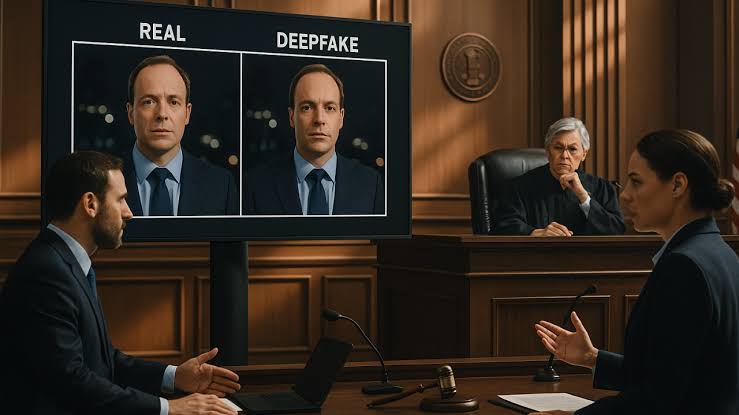
When Seeing Is No Longer Believing
For decades, photographs, video recordings, and audio files have played an important role in legal investigations. A security camera might identify a suspect, a phone recording might help establish a timeline, or a voice message might become central to a dispute. These forms of evidence have often helped investigators reconstruct events that would otherwise be difficult to prove.
But technology is changing the relationship between digital media and truth.
Artificial intelligence can now generate convincing images of events that never happened, reproduce a person’s voice from recordings, and create videos that make individuals appear to say or do things they never did. Traditional editing tools can also remove important context, rearrange events, or combine genuine footage with fabricated material.
The result is a growing challenge for the legal system: How can investigators and courts determine whether digital evidence accurately represents reality?
The issue extends far beyond identifying obvious fakes. A recording may be authentic but incomplete. A genuine video may be edited in a misleading way. A real voice may be combined with artificially generated words. Even a file that has not been altered can be presented with a false explanation of when, where, or why it was created.
For lawyers, judges, investigators, businesses, and ordinary individuals, the distinction between what a digital file appears to show and what it can actually prove is becoming increasingly important.
The future of digital evidence will depend not simply on better detection tools, but on reliable authentication procedures, documented evidence histories, qualified forensic analysis, and fair standards for evaluating competing claims.
The Rise of AI-Generated Evidence Challenges
Synthetic media, commonly associated with deepfakes, refers to digital content created or significantly manipulated using artificial intelligence or other techniques. It can include photographs, videos, voice recordings, and other material designed to imitate real people, events, or communications.
Some synthetic content is harmless. Filmmakers use digital effects, businesses create virtual demonstrations, and educators use generated media to explain complicated concepts. Problems arise when altered or fabricated content is presented as a genuine record of an event, especially when the material could influence a legal decision.
Imagine a workplace dispute in which an employee is accused of making a threatening statement during a meeting. A video appears to show the employee speaking, and the recording spreads among colleagues. The employee denies making the statement and argues that the video was manipulated.
Or consider a commercial dispute involving an audio recording that appears to capture a company executive approving a financial transaction. If the recording contains a cloned voice, the parties may disagree about whether the conversation ever occurred.
In a criminal investigation, a video circulating online might appear to place a suspect at a particular location. Yet the file could have been generated, edited, taken from another event, or presented without the footage that would establish its context.
These examples demonstrate why digital evidence cannot be assessed solely by how realistic it looks or sounds.
Modern generative tools can produce convincing content, while ordinary editing and compression can introduce visual or audio irregularities that may be mistaken for manipulation. Consequently, investigators must consider the entire history of the file, not just its appearance.
The challenge is also evolving quickly. Detection systems can help identify suspicious content, but their performance depends on the media, the manipulation technique, the quality of the file, and the system being used. No single automated test should be treated as a universal guarantee of authenticity.
What Does It Mean to Authenticate Digital Evidence?
Authentication is the process of establishing that a piece of evidence is what its proponent claims it to be.
In a legal proceeding, the relevant question is not necessarily whether a video looks genuine. It is whether there is a sufficient basis to conclude that the video is the recording it is claimed to be, depicts the relevant people or events, and has a foundation appropriate for the purpose for which it is being offered.
In the United States, Federal Rule of Evidence 901 generally requires evidence sufficient to support a finding that an item is what the proponent claims it is. Depending on the circumstances, authentication may be supported by a witness with personal knowledge, distinctive characteristics of the item, evidence about the process or system that produced it, or other appropriate methods.
For digital material, this can involve several questions:
- Who originally created or captured the file?
- Which device or system recorded it?
- When and where was it created, if that information can be established?
- Has the original file been preserved?
- Was the recording edited, enhanced, converted, or compressed?
- Can the people, voices, and events depicted be independently identified?
- Does the file support the specific claim being made about it?
These questions are related, but they are not interchangeable. Establishing that a file came from a particular device does not automatically prove that the people in the recording have been correctly identified. Establishing that a file has not changed since collection does not prove that the original recording was truthful or complete.
Authentication is therefore a foundation for evaluating evidence, not a declaration that every interpretation of that evidence is correct.
Courts may also distinguish authentication from other requirements for admissibility. Depending on the case, a recording could raise separate questions involving hearsay, relevance, expert reliability, privacy, or constitutional protections.
The exact requirements depend on the jurisdiction and the circumstances of the proceeding.
Provenance: Understanding a File’s History
Authentication asks whether an item is what someone claims it is. Provenance helps explain where the item came from and what happened to it over time.
For digital evidence, provenance may include the original source, capture device, creation date, editing history, transfers between systems, and the individuals or organizations that handled the file.
This history can be essential when a recording passes through multiple hands before reaching investigators.
A security camera may save an original video to a local system. A staff member may then export a segment, send it through a messaging application, and upload it to a cloud service. Another person might download the file, convert its format, and submit it to a lawyer.
Each step may affect the file’s metadata, quality, completeness, or available history. Some processes introduce compression or remove identifying information. Others may create new copies without preserving a clear record of the original.
Such changes do not automatically make evidence unreliable or fraudulent. A compressed copy may still accurately depict an event. The important issue is whether investigators can explain the file’s history and determine whether the changes affect the questions the evidence is being used to answer.
Provenance is particularly valuable when parties disagree about whether a file was manipulated. A documented history can help investigators distinguish between an original recording, a legitimate edited excerpt, a transformed copy, and a file whose origin cannot be established.
It can also reveal gaps. If the original file is missing, for example, an investigator may have to assess whether the available copy contains enough information for a reliable conclusion.
A transparent evidence history makes it easier for opposing parties and the court to evaluate the material instead of relying on unsupported assurances.
The Chain of Custody Still Matters
Provenance describes the history of digital content broadly. Chain of custody focuses on documenting the collection, handling, transfer, storage, and examination of evidence.
A sound chain of custody helps show who possessed the evidence, when they handled it, what procedures were followed, and whether any unexplained changes occurred.
In a digital investigation, this often begins with preserving the source material as soon as possible. Investigators may collect the original device or obtain the original file through an authorized process, document the circumstances of collection, and create a forensic copy using appropriate methods.
Cryptographic hash values can assist with this process. A hash function generates a digital value based on the contents of a file. If the file changes, its hash value will generally change as well. Matching hash values can help establish that two files contain identical data, subject to the reliability of the method and algorithm used.
However, a matching hash does not prove that the recording was genuine when first created. It shows that the compared files match; it does not establish who created the original or whether the depicted event actually occurred.
That distinction is crucial.
A fabricated video can be preserved perfectly. Its hash value may remain unchanged throughout an investigation, even though the video itself misrepresents reality. Likewise, a genuine recording may have been altered before investigators ever received it.
Digital preservation protects the evidence that was collected. Authentication and forensic examination address additional questions about its source, integrity, and meaning.
How Experts Examine Potentially Manipulated Media
When a digital recording is disputed, investigators may combine traditional investigative techniques with specialized forensic analysis.
The objective is not merely to ask an AI detector whether a file is fake. It is to evaluate the available evidence using methods appropriate to the material and the claims being investigated.
Forensic examination may include reviewing metadata, examining compression patterns, comparing different versions of a file, analyzing audio waveforms, and looking for inconsistencies in image structure or video frames. Investigators may also examine whether lighting, shadows, reflections, lip movements, background sounds, or other elements are consistent with the claimed recording conditions.
In voice-related disputes, experts may compare speech characteristics and recording conditions, while accounting for differences caused by microphones, background noise, compression, or ordinary changes in a person’s voice.
Investigators may also seek independent evidence. Security logs, access records, messages, eyewitness accounts, device information, and other contemporaneous records can help confirm or challenge the narrative attached to a recording.
No single method is guaranteed to settle every dispute. Some manipulation techniques leave detectable traces, while others may evade available detection systems. Genuine media can also produce anomalies that appear suspicious because of low quality or processing.
For this reason, responsible forensic analysis should explain what was examined, which methods were used, what limitations applied, and how strongly the findings support the conclusion.
An expert who identifies an inconsistency should not automatically claim that the entire recording is fabricated. Similarly, a detector that finds no known signs of manipulation has not necessarily established that the recording is genuine.
Reliable conclusions depend on the combined weight of the technical findings, the evidence’s history, and the surrounding facts.
Can Content Credentials Help?
One developing approach to digital trust is the use of content provenance standards, including the Coalition for Content Provenance and Authenticity’s C2PA specifications.
Systems based on these standards can attach verifiable information to digital content, potentially documenting details about its creation, editing, and processing. Cryptographic signatures can help establish whether recorded provenance information has been tampered with after it was signed.
For example, a camera or editing application might create a record identifying the tool used to produce a file and documenting certain changes made during editing. A later reviewer could inspect the available credentials to understand more about the asset’s history.
These records may help journalists, businesses, investigators, and courts evaluate the origin and handling of digital media.
However, provenance credentials are not a complete solution.
They may be absent from genuine files, removed during processing, or unavailable after content passes through systems that do not preserve them. Their presence also does not automatically prove that the recorded scene is truthful. A correctly signed file could still contain staged activity, misleading context, or inaccurate claims.
Likewise, a file without credentials is not necessarily fake.
Content credentials are best understood as one source of information among several. They can strengthen an evidence assessment when combined with reliable collection procedures, independent corroboration, and appropriate forensic methods.
What Standards Should Courts Apply?
The growing sophistication of synthetic media has raised questions about whether courts need entirely new evidence rules or whether existing legal principles can address the problem.
In the United States, the Federal Rules of Evidence already provide a framework for authentication, expert testimony, relevance, and other admissibility questions. Rules 901 and 902 address authentication, while Rule 702 governs the admissibility of qualifying expert testimony.
These rules serve different purposes. Rule 901 concerns whether evidence has an adequate foundation for identification. Rule 902 allows certain categories of evidence to be authenticated through specified procedures without requiring the same form of live foundational testimony. Rule 702 addresses whether expert testimony meets applicable requirements for relevance and reliability.
The existence of these rules does not eliminate the need to evaluate new technical problems. Courts must still determine how the principles apply to evidence produced or altered with unfamiliar tools.
At the same time, an allegation that a recording might be a deepfake should not automatically make the recording inadmissible. An unsupported accusation is not proof of manipulation, just as a confident claim of authenticity is not proof of genuineness.
The challenge is to establish fair procedures that allow legitimate concerns to be investigated without making every digital exhibit the subject of unlimited technical disputes.
Possible approaches include requiring a party who raises a specific authenticity challenge to identify its factual basis, allowing proportionate forensic examination when justified, and ensuring that parties have a meaningful opportunity to examine the methods and conclusions offered by experts.
Courts must also consider proportionality. A routine dispute over a low-quality security clip may not require the same resources as a criminal case in which a contested recording is central to the prosecution’s theory.
The appropriate response should reflect the importance of the evidence, the seriousness of the challenge, the available information, and the practical ability of the parties to test the claim.
The Risk of Rejecting Genuine Evidence
The danger of manipulated media is obvious: fabricated content could contribute to an incorrect judgment, damage a reputation, or lead investigators toward the wrong suspect.
But there is another risk. If courts and the public become convinced that any recording could be fabricated, genuine evidence may become easier to dismiss.
This creates a difficult balance. Legal institutions must remain alert to synthetic media without assuming that all digital recordings are unreliable.
A defendant should have a meaningful opportunity to challenge evidence that may have been manipulated. A claimant should not lose the benefit of a genuine recording simply because the opposing party invokes AI as a possibility. Investigators must remain open to competing explanations and avoid allowing assumptions about technology to replace proof.
The same principle applies outside the courtroom. Employers, schools, news organizations, and businesses should be careful before treating a viral recording as conclusive evidence of misconduct.
A responsible process asks what can be verified, what remains uncertain, and what additional information would help resolve the disagreement.
Digital skepticism is valuable when it encourages careful examination. It becomes harmful when suspicion itself is treated as a substitute for evidence.
A Practical Checklist for Handling Disputed Digital Evidence
When a video, voice recording, or image may be relevant to a legal dispute, a disciplined process can help protect its evidentiary value.
1. Preserve the original. Retain the original file or device when lawfully possible. Avoid unnecessary edits, conversions, or resaving that could change the available information.
2. Document the source. Record how the material was obtained, who supplied it, and any available information about the device, date, location, and circumstances of capture.
3. Maintain a clear chain of custody. Document transfers, storage, access, and forensic handling. Use appropriate integrity checks when creating and transferring copies.
4. Preserve context. Keep the full recording where available, not just the excerpt being circulated. Context may help establish what occurred before and after the recorded moment.
5. Seek independent corroboration. Compare the recording with relevant messages, logs, witnesses, or other evidence rather than relying on the file alone.
6. Use qualified experts when necessary. Select forensic professionals whose methods are appropriate to the issue. Their reports should explain the analysis, findings, uncertainty, and limitations.
7. Avoid overclaiming. Distinguish between evidence of alteration, evidence of synthetic generation, evidence of an incomplete recording, and proof that a specific event did or did not occur.
8. Follow applicable legal procedures. Authentication, disclosure, privacy, admissibility, and preservation requirements vary by jurisdiction and case type. Legal counsel should assess the relevant rules before evidence is collected, shared, or submitted.
These steps cannot eliminate every uncertainty, but they can make digital evidence easier to scrutinize and more defensible when challenged.
The Future of Truth in a Digital Courtroom
AI-generated media is forcing the legal system to revisit a question that has always mattered: What makes evidence trustworthy?
The answer has never been simply that a photograph looks convincing or that a voice sounds familiar. Reliable evidence depends on a foundation that can be examined, challenged, and evaluated against other information.
As digital tools become more powerful, authentication and provenance will become increasingly important. Forensic methods must continue improving, experts must communicate limitations honestly, and courts must apply evidence standards in ways that remain fair to all parties.
Technology will continue to evolve, and the legal system will need to adapt without assuming that either machines or human judgment are infallible.
Ultimately, the objective is not to make every video unquestionably trustworthy. It is to establish procedures that help distinguish what the evidence supports from what it merely appears to show.
In a world where a video can lie, the law must demand more than a convincing image.
It must demand a verifiable foundation.
References
- Federal Rules of Evidence — Rule 901: Authenticating or Identifying Evidence
- Federal Rules of Evidence — Rule 902: Evidence That Is Self-Authenticating
- Federal Rules of Evidence — Rule 702: Testimony by Expert Witnesses
- U.S. Courts — Advisory Committee on Evidence Rules, May 2024 Report
- National Institute of Standards and Technology — Examining Digital Media
- NIST — Reducing Risks Posed by Synthetic Content
- NIST — Guardians of Forensic Evidence: Evaluating Analytic Systems Against AI-Generated Deepfakes
- Coalition for Content Provenance and Authenticity — Content Credentials Explainer


Leave a Reply